
How a Canyon in the Hills Became the Hollywood Bowl
Clip: Season 9 Episode 4 | 8m 36sVideo has Closed Captions
How a natural amphitheater in a Hollywood canyon became an iconic music venue.
The Hollywood Bowl began as a natural amphitheater in a canyon before becoming one of the world’s most iconic performance venues. Through decades of design, community effort, and cultural moments, it evolved into a defining space for music in Los Angeles, reflecting the city’s connection to performance and public gathering.
Problems playing video? | Closed Captioning Feedback
Problems playing video? | Closed Captioning Feedback
Lost LA is a local public television program presented by PBS SoCal
How a Canyon in the Hills Became the Hollywood Bowl
Clip: Season 9 Episode 4 | 8m 36sVideo has Closed Captions
The Hollywood Bowl began as a natural amphitheater in a canyon before becoming one of the world’s most iconic performance venues. Through decades of design, community effort, and cultural moments, it evolved into a defining space for music in Los Angeles, reflecting the city’s connection to performance and public gathering.
Problems playing video? | Closed Captioning Feedback
Where to Watch Lost LA
Lost LA is available to stream on pbs.org and the PBS app.
Providing Support for PBS.org
Learn Moreabout PBS online sponsorshipBefore there was a Hollywood Bow there was an idea, an outdoor performing arts venue where symphonic music could be accessible not just to those who could afford it, but to everyone.
In 1920, two members of the Theater Arts Alliance went searching the Hollywood Hills for a place to make it happen and found it in a sagebrush canyon where their voices carried across the landscape, a natural amphitheater then called the Daisy Dell.
-Now, pardon a little low flying let's circle over the world-famous Hollywood Bowl, an outdoor theater embraced by hillsides that give it perfect acoustics.
-Next door to this now iconic venue, the Hollywood Bowl Museum holds documents that tell the story of how that idea became a reality.
Museum Director Liliana Grubisic and Archives Manager Michelle Beacham were kind enough to show me some of them.
-One of my favorite documents is actually the satisfaction of and there's a story that they actually burned a copy of it on the stage.
-Oh, like the original mortgage document.
We don't need this anymore.
-Wow.
-The Alliance secured the land, and the Hollywood Bowl was born.
From the beginning, the audiences came.
Among their earliest events was an Easter sunrise service that drew thousands of Angelenos into the hills before dawn, streetcars running as early as 3 in the morning to carry them the -The postcards are such an interesting part of the colle -We are going out to catch an Ea service daylight on Easter morni We leave here at 4:00 AM, and hear first trumpets up on mountains.
They actually had; there were people playing trumpe up on the ridge line.
Of course, there's no better pla to talk about the Hollywood Bowl history than the Bowl itself.
I met up there with writer Derek Traub.
His book for the LA Philharmonic tells the Bowl's 100-year histor not as a straight chronology, but as a set of ideas that have shaped the place from This is an LA institution, the Hollywood Bowl.
It's one of the most magical pla to spend a summer evening.
It's a marvel of engineering.
There's some amazing pictures from the early days with thousands of people.
-Yes, it was incredible.
It was literally just like a makeshift wooden stage with 100-piece orchestra on it.
There were about two dozen founders of this place and probably as many ideas for what to do with it.
Christine Weatherill Stevenson, who was one of the first of them she was a theosophist and believed in bringing togethe the world's seven great religion through seven different art form She wanted to do these religious plays here.
The other founders had other ide She packed up and went across th and created the Pilgrimage Playh which is now the Ford Theater.
The prevailing idea here came from a woman named Artie Mason C who was a piano teacher.
She had this idea for using this the Hollywood Bowl, for a summer of symphony concert 4 nights a week, 10 weeks out of the year, and this had never been done before anywhere.
William Andrews Clark Jr., who had just founded the orchest the Los Angeles Philharmonic, she tried to talk him into lendi orchestra for this summer-long s and he says, "No one is going to pay for these concerts.
I'm just going to be out of so much money for this."
In that first summer in 1922 that was just an overnight succe and it still is.
Not only did they not lose money but they started to make money, and in 1926, they finally had enough resource to put in the permanent benches.
This kind of shape of the amphit it's like a big balloon is desig by an architect named Myron Hunt -There's a connection there to the other bowl, right?
-Yes.
-The Rose Bowl.
-Yes.
The shape of this place it fits so naturally into the ca -Mecca for lovers of music and spectacles is Hollywood Bowl tremendous outdoor amphitheater where the outstanding orchestras and soloists of the world perfor With a capacity for some 12,000, this great bowl presents program of every type for every taste.
-The natural contours of the can were smoothed over with concrete with benches, and now we have these boxes here Did I read that that actually had unfortunately the effect of -ruining the natural acoustics?
-Yes.
Unfortunately, there was this belief in the tim that man can conquer nature and improve upon it, like we have LA River.
This sort of similar idea happen where it's like we can make this dusty canyon into this perfect canyon by pouring concrete and putting these permanent benc which is nice; we have this permanent seating a but it did start to mess with that natural resonance.
The sound is better now that it ever has been, but it's been a journey over the last 100 years to recreate what was originally -This amazing shell we see here is not the first.
-Yes.
A lot of people think when we say bowl, the bowl indicates the shell.
No, the bowl is the canyon.
The name bowl predates the shell [?]
started doing concerts here in 1921, 1922.
The first shell doesn't go in until 1926 for a few reasons.
One that was when they laid all the concrete and the sound started to get won so they're like, "Okay, let's pu something to hopefully reflect the sound out a little bit bette The second reason was we had an orchestra rehearsing here during the day in the summer, and they were tired of sitting under the hot sun.
-I can imagine.
-We cycled through four shells in the 1920s while they were playing around with the aesthetics and the acou and could never quite settle on Then, in 1929, they put in a she and we have the stock market cra and other kind of priorities cha Though they didn't think it was going to be a permanent s they left it, and it survived until 2003.
It's a pretty good run.
-After the war, the Bowl fell on really hard tim and it was in danger of closing for a while.
-In 1951, the Bowl went bankrupt They started with this big opera production that no one showed up for.
There was some bad weather.
There was some misgaging of the interest in it.
They were out of money to pay the musicians.
We had survived the Great Depres and World War II and all these ups and downs.
All of a sudden, in 1951, we weren't going to have a Hollywood Bowl season for the first time in almost 30 years.
A philanthropist and a business leader and a brilliant woman named Dorothy Chandler was roped She was the wife of Norman Chand who was the publisher of the LA -The ruling family of Los Angele -essentially.
-Yes.
You could take the Vanderbilts and the Astors and the Rockefell and put them into the one, and that's the Chandlers.
That's how influential and important they were.
Dorothy Chandler was this society wife, and so she went to work as a volunteer.
They bring her in 1951.
The place is in $100,000 worth of debt.
In 12 days, she turns it around.
She moves into our then music director's house, Alfred Wallenstein, gets out his Rolodex, calls every great musician across the country who's been playing here for deca She had that Artie Carter vibe of the community needs to be bou and invested.
She started a fundraising campai used her husband's newspaper, the LA Times, to advertise it.
They raised the $100,000, got the place back open in 12 da -Artie Carter championed classical music.
The Hollywood Bowl stages a lot of popular music shows, to What would she think about that?
How would she feel about Jimi Hendrix or the Beatles up h -Artie Carter would probably be a little skeptical of all of the that we present at the Hollywood She was a bit of a purist.
We have, for all of our classica and all of our jazz shows, Tuesdays, Wednesdays, Thursdays, we offer thousands of $1 tickets Correcting for inflation, a $1 ticket in 2026 is a lot che than a $0.25 ticket in 1926.
I think that the fact that the egalitarian impulse of the Hollywood Bowl is still alive and well, I think would make her very happ -It's easy to say that Carter was ahead of her time, but Carter and Dudamel, this democratizing impulse, isn't universally shared in the classical music community even today.
-Yes.
No, it was very controversial at to do just symphony concerts for Still today, we have the largest audience for orchestral music in the coun gathered here each summer.
Other orchestras, other places a how do you do that?
It's like, we can't tell you.
You just need to go back in time and create a Hollywood Bowl.
Amazing.
-Cheers.
-Cheers to another 100 years.
-There you go.
 New
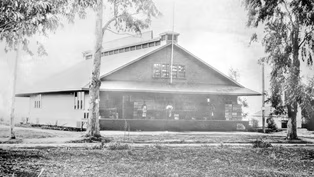
NewBefore Soundstages: Hollywood’s First Feature Film Was Made Here
Video has Closed Captions
Clip: S9 Ep4 | 8m 36s | The barn where Hollywood’s first feature film was made. (8m 36s)
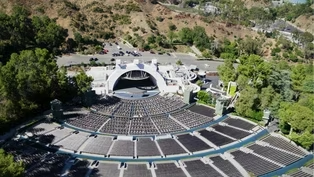
A Bowl, A Barn & A Tower: Birthplaces of the Entertainment Industry (Preview)
Preview: S9 Ep4 | 30s | From a barn to a bowl to a tower, the early history of Hollywood. (30s)
 New
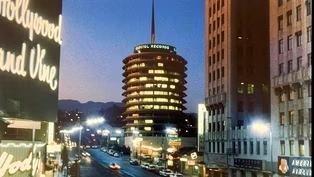
NewThe Hollywood Landmark Where Music Legends Made History
Video has Closed Captions
Clip: S9 Ep4 | 9m 20s | Inside Capitol Records Tower, where music legends shaped Hollywood history. (9m 20s)
Providing Support for PBS.org
Learn Moreabout PBS online sponsorship













Support for PBS provided by:
Lost LA is a local public television program presented by PBS SoCal